
This is the third post in a series on the connected crises of American society, culture, and Christianity – please read the first post here and second here if you haven’t already.
The American Christian crisis is connected with both culture and politics, and what I mean when using the word “politics” is: the way in which people interact with each other and make rules for living together in groups or societies.
Politics in this way is foundational to being human – as ancient Greek philosopher Aristotle once said, “Man is by nature a political animal,” meaning that one of the core marks of humanity is that we are social and work together in groups.
We desire to be in community, and where there is community, there is a need for that community to agree on what the roles and responsibilities are of the different people within that community.
Christianity is very political in this regard because Jesus established that his Kingdom, the Kingdom of God, does not function in the way human kingdoms do –
“The kings of the gentiles lord it over them, and those in authority over them are called benefactors. But not so with you; rather, the greatest among you must become like the youngest and the leader like one who serves” (Luke 22:25).
“Blessed are the poor in spirit, for theirs is the kingdom of heaven. Blessed are those who mourn, for they will be comforted. Blessed are the meek, for they will inherit the earth. Blessed are those who hunger and thirst for righteousness, for they will be filled. Blessed are the merciful, for they will receive mercy. Blessed are the pure in heart, for they will see God. Blessed are the peacemakers, for they will be called children of God. Blessed are those who are persecuted for the sake of righteousness, for theirs is the kingdom of heaven” (Matt 5:3-10).
“My kingdom does not belong to this world. If my kingdom belonged to this world, my followers would be fighting to keep me from being handed over…” (John 18:36).
And yet, because Jesus’ Kingdom is one that works through service and love; has to be joined voluntarily; and exists in all worldly kingdoms, there is a tension for the Christian who belongs to the Kingdom of God but also has to live within the kingdoms of the world.
The constant challenge for Christians regardless of what country they live in is allowing their identity to become too attached to their country instead of with Christ and the Church.
And that is the primary problem I see with American Christianity – there are too many of us who overemphasize “American” instead of “Christian,” and allow “American” to define what we mean when we say “Christian.” Too many of us see ourselves first and foremost as Americans instead of as Christians, and we care more about what happens to America than we do to God’s Kingdom.
This is nothing unique to American Christians, but it can lead to incredibly dangerous consequences.
For example, how does the following statement make you feel?
“Loyalty to God and loyalty to [America], faith in God and faith in [America], love for our eternal home and love for our [American] home, love for our [American] brother and Christian love of neighbor, striving for the kingdom of God and striving for [America’s republic], being an [American] and being a Christian – these notions are indissolubly linked with one another. God and his kingdom are the source of [American] strength, Jesus’ world-conquering faith is the core of [American] faith.”
I wouldn’t be surprised if that drew some “amens” from some readers, as it does seem to capture a lot of the emotion and sentiment I’ve noticed in a lot of American churches.
The problem? In its original form, this statement used “Germany” instead of “America” – this was written by Julius Leutheuser in 1935, an avid supporter of the Nazi Party and a Lutheran pastor, in a short book written encouraging German Christians to more fully support the Nazis.
A not-insignificant number of Christians were pro-Nazi in 1930s Germany, and if the similarities between their statements and those coming from several American Christians don’t give us great pause, then I’m not sure what will.
“Positive Christianity is and will ever remain a biblical Christianity. ‘Positive’ means nothing other than ‘fundamental.’ What is at stake here is the spiritual liberation of the nation from liberalism and [socialism], and this liberation is possible only through the book that ‘preaches Christ.’”
“The fact that until the emergence of [liberalism and socialism] most German families actually read the Holy Scriptures is attested everywhere by copies of the Bible that have come to us from the grandparents’ generation, which reveal in an absolutely amazing way traces of enduring use…How did it happen that this book began to lose its unique character as a people’s book?…liberalism and [socialism].” – Friedrich Wieneke, Outline of German Theology, 1933
“We see in [the church], rightly conceived, a living, active Christianity that, in our view, is rooted not in mere compassion but rather in obedience to God’s will and gratitude for Christ’s death on the cross. Mere compassion is charity, which leads to arrogance coupled with a guilty conscience that makes a people soft.” – The Handbook of the German Christians, 1933
“In their origins, Christianity and National Socialism both go back to God…Some kind of living relationship between the two must therefore also be possible in the present.” – Arnold Dannenmann, The History of the ‘German Christian’ Faith Movement, 1933
“With all the strength of our faith and our active life we serve the man [Adolf Hitler] who has led our people out of servitude and misery to freedom and true greatness.” – The Godesberg Declaration, 1939
I say this with zero partisanship and only as an observation: many white, evangelical American Christians currently have this kind of devotion to a particular conservative vision of America and what it means to be an American, and for many, this devotion is more important and more central to how they view themselves than their commitment to Jesus Christ is – in many cases, in fact, these Christians don’t even see how there is a contradiction between America and Jesus.
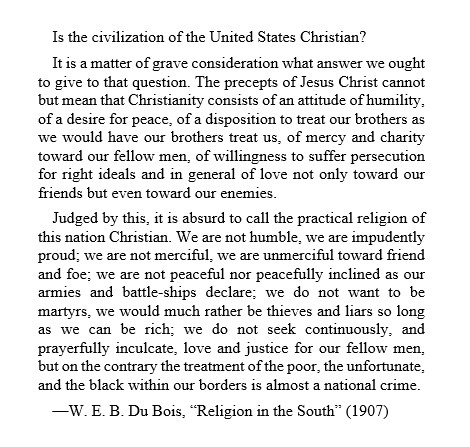
If that’s true, for Christian’s like this, “Jesus” is not the real, historical Jesus, but is instead a mythical version of Jesus being used (unintentionally, for the most part) for idolatry, the idolatry of America.
The gist of the prophetic warning American Christians need to hear is that many of us have effectively abandoned Jesus’ message of advancing the Kingdom of God through humility, self-sacrifice, and love and have instead decided we prefer using Caesar’s methods of empire (intimidation, fear, and violence) to politically force our morality and beliefs on others.
We need to return to Jesus, or, perhaps for some of us, meet the real Jesus for the first time. And we need to be holding our leaders – all leaders, regardless of their party affiliation – accountable, calling them out when they do something that is opposed to God’s Kingdom. It is not enough to sit in silence. As Dietrich Bonhoeffer said regarding the Church’s lack of action during the Nazi regime, “Silence in the face of evil is itself evil; God will not hold us guiltless. Not to speak is to speak. Not to act is to act.”


 David S. Wisener