
Before tackling the three crises in America I talked about in my last post here, there is a little-recognized sin we need to discuss.
Whenever Christians debate about what sin is the one from which all other human problems emerge, pride is usually named. And that’s probably true – the root of the Fall as told in the story of Adam and Eve is wrapped up in a decision to doubt God and, ultimately, make our own decisions, which is a form of pride, a desire to more or less have the power and authority of God.
But there’s another root problem we all struggle with, and it’s the main culprit behind much of the evil committed in the world. Because when you think about it, there are very few people who decide to “be evil” – in their minds, their actions are justified.
Many addicts don’t recognize that they’re addicts; very few racists realize they’re racist.
So how is it that even Christians can become complicit in some of the most heinous events in history such as the Holocaust?
It’s through our powerful ability to deceive ourselves.
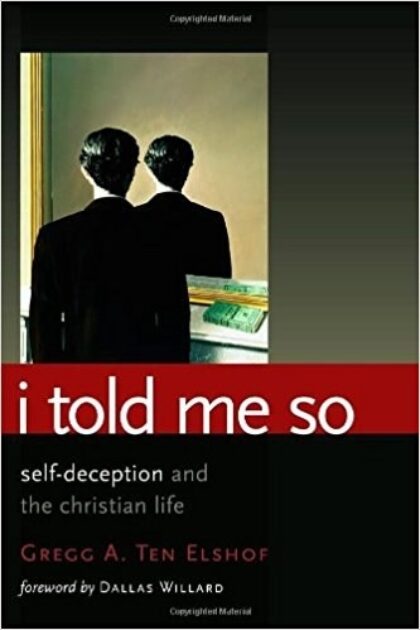
Author Greg Ten Elshof wrote an important short book called I Told Me So: Self-Deception and the Christian Life that dissects how all of us have the tendency of allowing ourselves to be deceived about several aspects of life.
“A mother somehow manages not to notice the obvious signs that her son is on drugs. A wife does the same with respect to her husband’s affair. All of the evidence is easily available. Yet it goes unseen. The young man puts out of mind the horrors of the sex-slave industry driving the pornography business and convinces himself that these women actually enjoy their work. The politician convinces himself that his lofty ends justify morally ambiguous means (or worse). The director of a Christian non-profit organization manages to find sincerely compelling a perspective from which money donated to the ministry can legitimately be used to pay for an extravagant personal vacation or, perhaps, a private jet.”
As Ten Elshof notes, we have a remarkable ability of ignoring the facts when we’re motivated to.
Ironically, one of the most important factors behind how we’re able to lie to ourselves without catching on is because nearly all of us believe we are genuine with ourselves and not self-deceived.
“If we can convince ourselves that we’re authentic people – that we’re not self-deceived…we can experience the satisfaction associated with saying, ‘Whatever else is true of me, I’m honest with myself and with others. I know myself. I’m real.’…a major strategy for the self-deceiver is simple subject avoidance. We simply resist attentive focus on the painful topic and are thereby enabled to persist in our belief. So we resist the topic of self-deception.”
Bluntly stated, depending on what topic we’re talking about, finding the truth isn’t the most important thing to most of us, and that is a root to how self-deception thrives.
This is especially true and easily seen in our political opinions.
Politics is very complicated. The issues that impact society – the economy (both domestic and international as well as understanding the variety of economic theories and how there are elements of truth within each), foreign relations, tax theories, infrastructure management, and so much more – are not simple.
And, again, I’ll be blunt. According to a Gallup survey from 2020 that analyzed Department of Education data, over half of Americans between the ages of 16 and 74 read below a sixth-grade level. Meaning, on average, we’re not very smart.
Many Americans are not able to understand – nor are they interested in trying to understand – the various complex issues that are involved in government.
So when it comes to our political opinions, most of us rely on vibes – we like the kinds of people in [insert political party] more than we like the kinds of people in [insert other political party].
That is what “tribalism” is – we support groups, or tribes, without critically thinking about anything else, and we also fear the possibility of being “othered” and, effectively, cast out of whatever tribe we associate with if people found out we don’t always agree with the tribe.
And that’s all we consider when it comes to how we vote.
So we don’t go looking for the truth when it comes to politics – we’re strongly motivated to continue belonging to our particular tribe, so we don’t want to know if there is information out there that would call our political beliefs or our candidates into question.
An example from my life, removing the president in question so you the reader don’t tune me out: a former coworker of mine once told me how impressed he was with the work ethic of a particular president, confidently stating he was the hardest-working president of his lifetime.
I stated that I found that hard to believe given that, as a matter of record, this president had – by far – taken more golfing days than any other president. My coworker balked and blew it off, which is a prime example of self-deception, of ignoring or discrediting information that contradicts what we want to believe.
Ten Elshof quotes philosopher William James, who said “My experience is what I agree to attend to. Only those items I notice shape my mind.” Which is what we do with politics, and which has become far easier to do with the rise of social media, podcasts, and partisan-tailored news networks and radio stations: we only digest information coming out of our preferred tribe that reinforces our beliefs.
We don’t pay any attention to information that could prove us wrong.
There is much more to be said about other methods we use to deceive ourselves (please do read Ten Elshof’s book, it is life-changing if you allow it to be), but I think this much is sufficient for our purposes here – you (and I) have to be open to the reality that we’re likely deceiving ourselves in different ways.
The antidote, ultimately, is to care about the truth above all else – more than we care about belonging to tribes or what people think about us (or what we might think about ourselves). We need to want the truth regardless of the consequences.
We can’t avoid the information that might change our opinions, which means we need to read, listen to, and watch sources that aren’t just echo chambers of the things we like.
That’s how my political views have changed over the course of my life. I genuinely cared about what was true and wanted to learn more about issues than just the very basics coming from people I already agreed with. I expanded my sources of information so I wasn’t limited to the biases of only a handful of people.
I accepted the reality that Jesus broke the conventions of his tribe (ancient Judaism) to the point that he was killed for it, so as his disciple, I have to seek after the truth like he did.
And you do, too.
So what are you hiding from?

 David S. Wisener
One thought on “The sin of self-deception: Christian Idolatry, Part II”